Core work has a reputation for being tedious.
Endless crunches. Planks held until your arms shake. Movements that feel punishing rather than purposeful.
Inversions and side planks are a completely different experience. They build serious core strength – but they do it by challenging your balance and stability at the same time. Your body has to work smarter, not just harder. And that makes them far more interesting to practice than anything you’d do on a gym floor.
This session works through several variations with something for every level. If you’re newer to these movements, the modifications matter – start there and build gradually. If you have an existing practice, use this as an opportunity to slow down and find real control rather than just getting through the reps.
Why Inversions and Side Planks Work So Well Together
Most core training works the front of the body – the muscles you can see in a mirror. Inversions and side planks work the whole system – front, back, sides, and deep stabilizing muscles that most people never directly train.
Side planks target the obliques and lateral core – the muscles that run down the sides of your trunk. These are the muscles that stabilize your spine during rotation and protect your lower back during almost every movement you make. Most people have significantly weaker lateral core strength than they realize, which is why side planks can feel so challenging the first time.
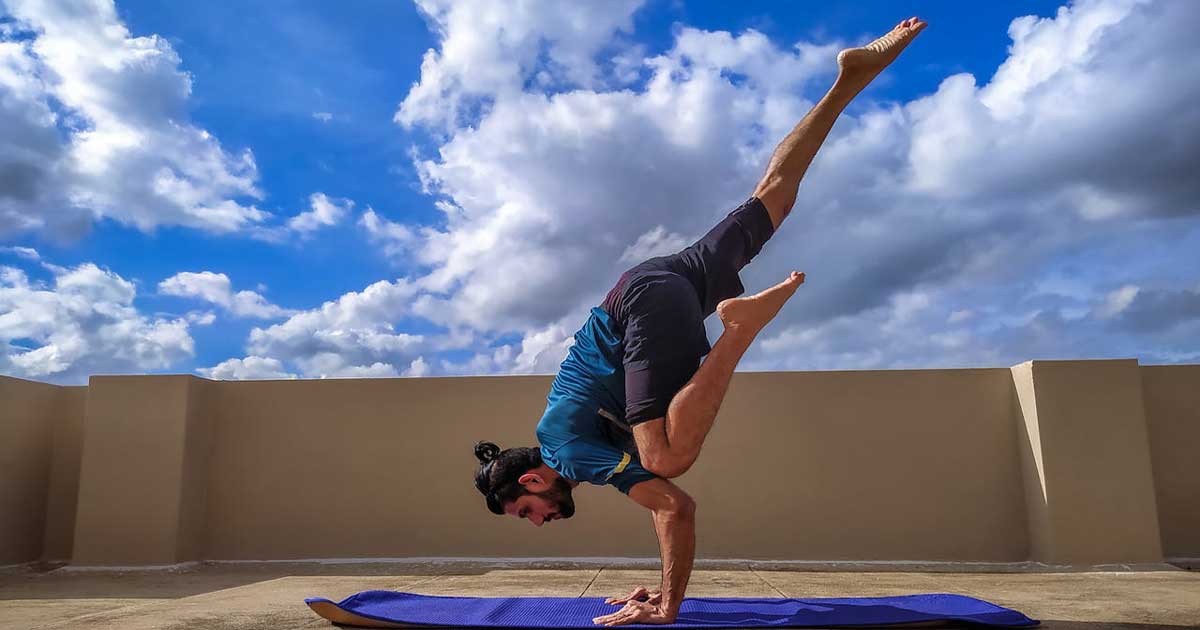
Inversions shift your relationship to gravity entirely. When you’re upside down or partially inverted – in a supported headstand, legs-up-the-wall, or even a forward fold – your core has to work differently to maintain stability. They also build shoulder strength, improve circulation, and have a calming effect on the nervous system that most people notice immediately.
Together they create a complete core practice that builds strength, balance, control and body awareness all in one session.
Watch the Video First
Scottie works through the full sequence below – watch it through once before you start so you know where you’re headed with each movement.
The Movements – What to Focus On
Side Plank – Foundation
Start in a standard plank position on your hands or forearms. Shift your weight onto your right hand and the outer edge of your right foot. Stack your feet or stagger them if you need more stability. Lift your left arm toward the ceiling and open your chest. Hold for 4-6 breaths.
The key here is keeping your hips lifted – the tendency is to let them sag toward the floor. Drive them up and keep your body in one long diagonal line from head to heel.
Modification: Drop your right knee to the mat. This takes significant load off the lateral core while still working the movement pattern. Build from here.
Side Plank Variations
Once you have the foundation, Scottie works through several variations that increase the challenge:
- Thread the needle – from side plank, take your top arm and thread it under your body, rotating slightly, then return. This adds rotation to the lateral stability challenge.
- Hip dips – from side plank, lower your hip toward the floor and lift it back up. Slow and controlled, not bouncing.
- Leg lift – from side plank, lift your top leg toward the ceiling. Demands significantly more lateral stability and hip control.
Take each variation only as far as your form holds. The moment your hips drop or your form breaks down, come back to the foundation.
Supported Inversion – Dolphin Pose
From a tabletop position, lower your forearms to the mat with elbows shoulder-width apart. Tuck your toes and lift your hips up and back into Dolphin – similar to Downward Dog but on your forearms. Press through your forearms, draw your shoulder blades together, and let your head hang. Hold for 5-6 breaths.
This builds the shoulder and upper back strength needed for deeper inversions while keeping the movement accessible. If your hamstrings are tight let your knees bend slightly.
Supported Headstand (When Ready)
From Dolphin, walk your feet in closer to your elbows. Place the crown of your head on the mat between your forearms – your hands should cradle the back of your head. Press firmly through your forearms and begin to shift your weight forward. Lift one foot, then the other, finding your balance against a wall if needed.
This is a pose that deserves patience. Don’t rush toward it. Strong Dolphin practice over weeks and months is the right preparation. When you do attempt it, a wall behind you is not a crutch – it’s good practice.
If inversions aren’t accessible yet – legs up the wall is a genuine inversion that most people can do comfortably. Lie on your back close to a wall and extend your legs up against it. Hold for 2-3 minutes. All the circulatory and nervous system benefits, none of the balance requirement.
A Few Things Worth Knowing
Shoulders before headstands. The most common mistake with inversions is going for the headstand before the shoulder strength is there to support it. Dolphin pose tells you exactly where you are – if it’s hard to hold for 5 breaths your shoulders need more time. That’s useful information, not a failure.
Wrists need attention. Side planks on the hands put significant load through the wrists. If yours are sensitive, work on your forearms instead – same movement, different entry point.
One side will be harder. Everyone has a weaker side in lateral core work. Give it a few extra breaths rather than rushing through to match the stronger side. The gap closes with consistent practice.
Breathe through the holds. Holding your breath during a challenging pose is the most reliable way to make it feel harder than it needs to be. Steady breathing is what makes a 6-breath hold manageable.
Keep Building
Inversions and side planks build the kind of functional strength that shows up everywhere else in your practice and your daily life – better posture, more stability, less lower back tension, and a body that feels genuinely capable.
If you want to keep building from here the simple yoga flow is a good complement – a full body sequence that pairs well with targeted core work. And if tight hips are limiting your range in any of these movements the yoga stretches for tight hips addresses that directly.
Show up for the core work. It pays back in everything else.