
Japan takes bathing seriously in a way that most of the world doesn’t.
It’s not just relaxation. It’s ritual. It’s culture. It’s centuries of accumulated wisdom about what water, heat, and stillness do to a human body and mind when you stop rushing and actually let them work.
Japan’s major travel agents have voted Kusatsu Onsen the number one onsen in Japan for over sixteen consecutive years. In a country with thousands of hot spring towns, many of them extraordinary, that’s a remarkable statement. At an altitude of 1,200 meters above sea level, Kusatsu offers skiing in winter, hiking in warmer seasons, and relaxation year round.
For anyone serious about wellness travel, it belongs on the short list.
The Water – What Makes Kusatsu Different
What sets Kusatsu apart is its exceptionally high-quality, sulfur-rich hot spring water, which is naturally acidic and believed to cure a wide variety of ailments. The highly acidic water is believed to have strong antibacterial properties, making it effective for skin conditions, cuts, burns, and other ailments – and the minerals promote blood circulation, offering relief from fatigue and contributing to overall relaxation.
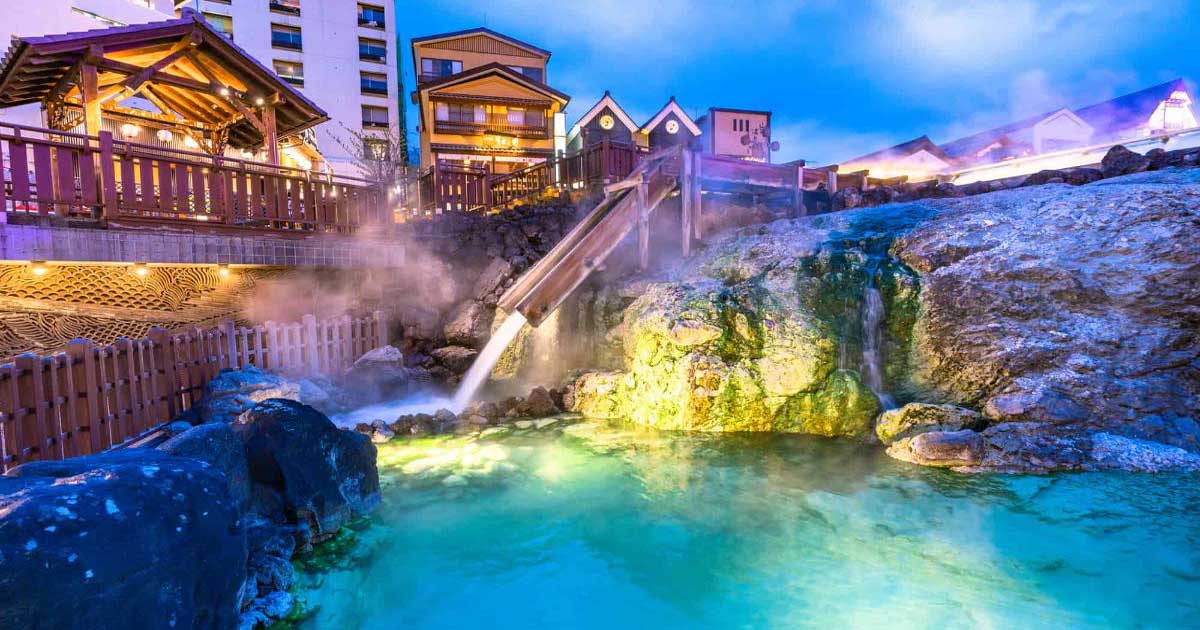
At the heart of the town is the Yubatake – the “hot water field.” A steaming, photogenic cascade of mineral-rich water that supplies the area’s baths and serves as the visual and spiritual center of the town. You’ll find yourself returning to it throughout the day – morning mist, afternoon light, evening lanterns. It’s the kind of thing that becomes the memory of the trip.
The Bathing Culture – More Than Just Soaking
Kusatsu’s bath culture has been refined over centuries and it has layers worth understanding before you arrive.
Yumomi is Kusatsu’s unique tradition – a water-stirring ritual performed by local women singing folk songs, used to cool the hot spring water without diluting it. You can watch the performance at Netsu-no-yu or participate yourself. It sounds simple. In practice it’s a window into something genuinely rare – a living tradition that has been performed in this place for hundreds of years.
Onsen hopping is the local practice of moving between different public bath facilities throughout the day – visiting day-use bath facilities to experience different hot springs, ideally wearing a yukata (light cotton robe) between baths. The public baths in Kusatsu are free and plentiful. This is how locals use them and it’s how you experience the town most authentically.
Otakinoyu is one of the most celebrated bath facilities – offering multiple baths at different temperatures, maintained through natural cooling rather than dilution, preserving the full mineral content of the water. Private Shakunage baths are available for couples.
Sai-no-Kawara is the open-air bath in a park setting – a large outdoor pool surrounded by trees and steam vents, free to use, and one of the most peaceful bathing experiences in the town.
Staying in a Ryokan
The right accommodation in Kusatsu is a ryokan – a traditional Japanese inn. Staying in a ryokan gives you the full onsen experience, complete with tatami mat rooms, Japanese-style meals, and access to private or public baths.
Most ryokan in Kusatsu have their own private hot spring baths fed directly from the source. The rhythm of a ryokan stay – morning bath, kaiseki breakfast, a walk through the town, afternoon bath, a multi-course dinner, evening bath – is one of the most restorative things you can do for yourself. By day two your nervous system has downshifted in a way that most vacations never achieve.
Kusatsu does not have a train station – a bus from Naganohara-Kusatsuguchi Station provides direct service to the town, about two and a half hours from Tokyo by express train. The slightly effortful journey to get there is part of what makes it feel like a genuine retreat.
When to Go
Winter is particularly recommended for Kusatsu – as early as November snow begins to fall and the surrounding area turns white, creating a dreamlike world with steam rising from snowy scenery. Nearby ski resorts make it possible to combine winter sports with hot spring recovery. Procana
Spring brings cherry blossoms to the lower elevations and the first wildflowers to the mountain paths. Summer is cooler than most of Japan at altitude and excellent for hiking. Autumn brings fall foliage that rivals anything in New England.
There is no bad time to go. Choose based on what experience you’re after.
Plan Your Visit
Kusatsu is a small town and accommodation books up, particularly on weekends and in peak seasons. Plan ahead and book your ryokan directly or through a reputable booking platform.
Find Hotels and Ryokan in Kusatsu on Orbitz
A few things worth knowing before you go:
- Tattoos are not permitted in most public baths in Japan including some in Kusatsu – private baths in ryokan are the solution if this applies to you
- Cash is still widely used in Kusatsu – bring enough for meals, baths and souvenirs
- Basic Japanese phrases are appreciated – English is limited in this small mountain town
- The Yubatake is most atmospheric at dusk and after dark – don’t miss it in the evening light
Search Flights and Travel to Japan on Orbitz
A Wellness Pilgrimage Worth Making
Kusatsu Onsen is not a resort in the Western sense. It’s a town that has organized itself around the practice of healing and rest for centuries. The commercial layer is thin. The authenticity runs deep.
For anyone who practices yoga, meditation, or any kind of intentional wellness routine, spending a few days in a place where restoration is the entire point – where the infrastructure of the town exists to support your wellbeing – is a genuinely different experience from a beach vacation or a city trip.
It stays with you.
For more on intentional wellness travel the travel and vacation page explores what makes a trip genuinely restorative versus just a change of location. And if you want to arrive at your ryokan with a body that’s ready to receive the experience, the miracle of meditation is a good daily practice to carry with you on the journey.